Get in touch to unlock huge benefits

    Recommend PatchitUp

    Please share us with your friends!

    Follow by Email
    LinkedIn
    Share
    Copy link
    URL has been copied successfully!

    First Name
    Last Name
    Email
    Message
    The form has been submitted successfully!
    There has been some error while submitting the form. Please verify all form fields again.

    Drywall Cracks Above Doors and Windows in Saginaw?

    August 20, 2026

    Aditya

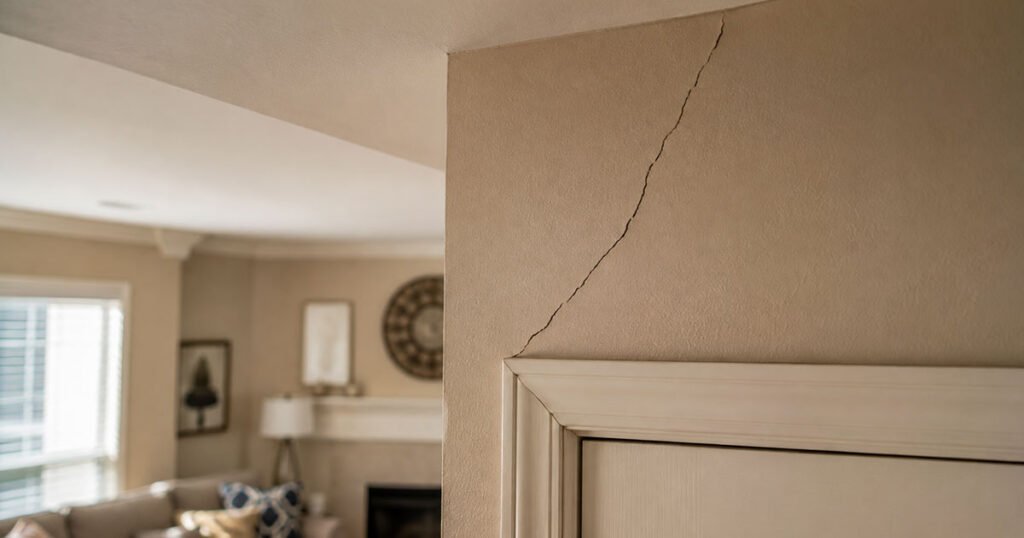
    Drywall crack above doors and windows, running to the ceiling in a Saginaw TX living room

    Most drywall cracks above doors and windows in Saginaw homes are thin stress cracks caused by seasonal clay soil movement, and they’re cosmetic. Start worrying when the crack is wider than 1/8 inch, runs diagonally from the corner, or shows up alongside doors that stick and floors that slope. That combination points to foundation movement, not ordinary settling.

    Why cracks show up over openings first

    Every door and window punches a hole in what would otherwise be a solid wall. The short strip of drywall above that opening carries stress from both sides, and it has a seam running through it.
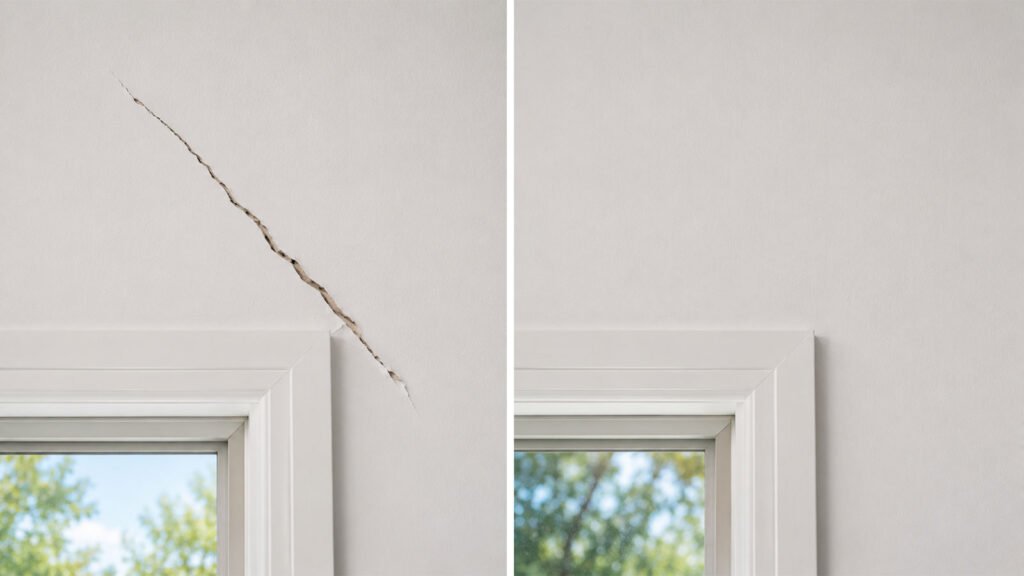
    Before and after drywall crack repair above a window frame, cracked wall left, smooth wall right
    Left, the crack above the window casing. Right, the same wall after taping, feathering and texture matching.

    So when the framing flexes even a little, the tape over that header lets go first. That’s the whole reason you see drywall cracks above doors and windows long before you see anything in the middle of a blank wall.

    In practice, the most common call we get in Saginaw is a thin line running from the top corner of a door frame up toward the ceiling. Hairline. Usually seasonal.

    Cracks at openings are normal stress points, not automatic red flags.

    Settling or foundation trouble? How to tell

    Here’s a check you can do yourself in about ten minutes, with a flashlight and a marble.

    Probably cosmetic:

    • Hairline width, roughly a business card thick
    • Runs straight up from the corner or straight along a tape seam
    • Doors and windows still latch fine
    • The crack widens in late summer and tightens after a wet stretch

    Possibly structural:

    • Wider than 1/8 inch, or wide at one end and pinched at the other
    • Runs diagonally, around 45 degrees off the corner
    • Doors drag, stick, or won’t catch the latch
    • Gaps opening at baseboards, sloping floors, cracked exterior brick
    • The same crack returns within a few months of a proper patch

    One crack on its own is a maintenance item. Three or more of the structural signs showing up together is different.

    If you’re seeing diagonal cracks plus sticking doors plus sloped floors, call a structural engineer before you call anybody with a mud pan.

    What Saginaw’s clay soil is doing under your slab

    North Texas is built on clay that never sits still. Houston Black, the official Texas state soil, runs 46 to 60 percent clay and opens ground fissures over 4 inches wide and 12 inches deep during dry spells, staying open 90 to 150 days in a typical year (Soil Science Society of America).
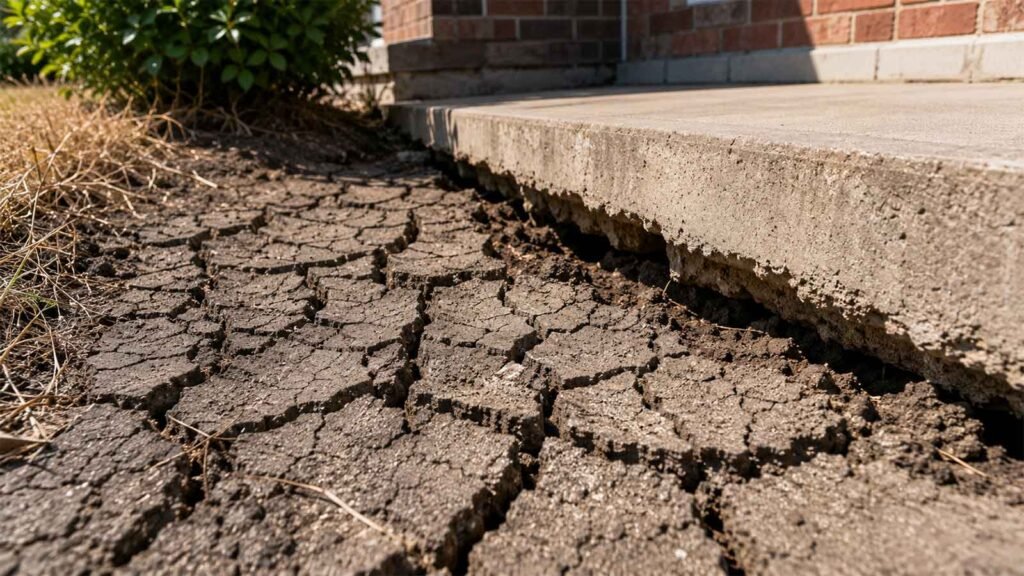
    Dried cracked clay soil pulling away from a brick home's concrete slab foundation in North Texas
    A dry Texas summer opens gaps like this around the slab. When the rain comes back, the clay swells shut again and your walls feel every bit of it.

    That’s not gentle pressure. Expansive soil can push against concrete with as much as 5,500 pounds per square foot (InterNACHI).

    Texas regulators put numbers on the fallout. A Texas Department of Licensing and Regulation bulletin cites research showing expansive soils affect roughly 25 percent of all structures, with about 60 percent of new homes seeing minor damage and 10 percent taking significant damage (TDLR IHB TB 10-01).

    So a hot Tarrant County August dries the soil ring around your slab, autumn rain swells it back, and your walls record the whole cycle. Drywall cracks above doors and windows are often just the receipt.

    Should you fix it now or watch it?

    If the crack is hairline and everything still opens and closes, watch it for one full wet-dry cycle. Mark both ends with a pencil, write the date next to it, and check again in three months.

    Still the same size? Patch it. Grown noticeably, or now catching a fingernail? Get eyes on the foundation first. Patching over active movement just buys you a fresh crack next season, which is the same pattern behind hairline cracks around doors and windows in older homes.

    Fair warning: repainting one wall to hide a crack usually looks worse than the crack did.

    What a real repair looks like

    Caulk is not a repair. It shrinks, it flashes under paint, and the line comes back.
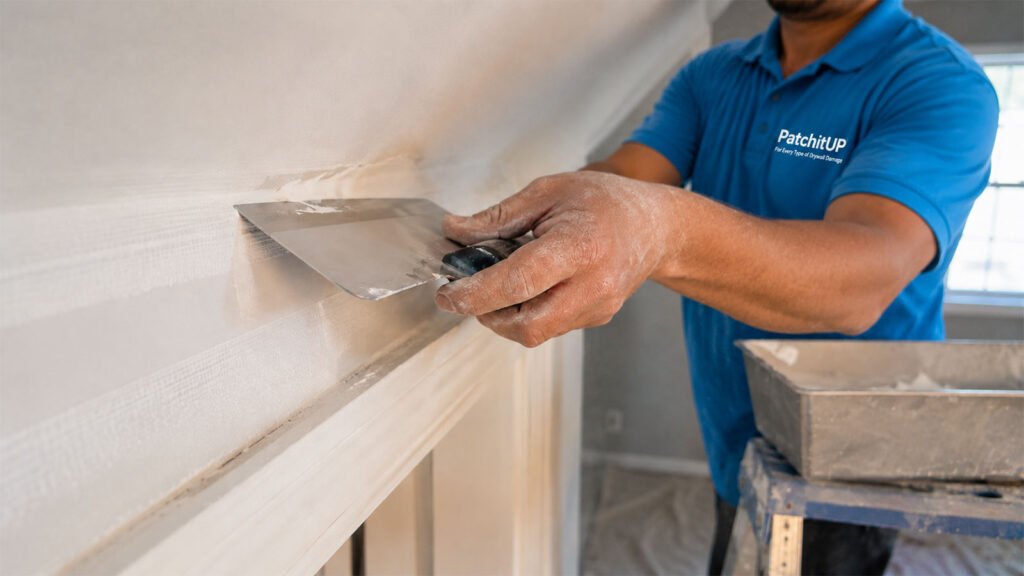
    PatchitUP technician smoothing joint compound over a taped drywall seam above a window frame
    Mesh tape, then three feathered coats out to 10 or 12 inches. That’s what makes a patch vanish. Caulk never does.
    1. Cut the crack into a shallow V so there’s something for compound to grab.
    2. Re-tape the seam with paper or mesh tape bedded in joint compound.
    3. Feather three coats out 10 to 12 inches so the patch has no visible edge.
    4. Match the texture. Most homes around Saginaw wear knockdown or orange peel, and a bad texture match is more obvious than the original crack ever was.
    5. Prime the patch, then paint corner to corner instead of spot-touching.

    Deeper damage changes the math, and that’s the point where you decide whether to patch, skim coat, or replace the drywall.

    Sanding and texture matching are where DIY patches give themselves away.

    Bottom line and next step

    Drywall cracks above doors and windows are usually your house responding to Saginaw’s clay, not a structural emergency. Measure them, date them, and watch one season before you panic.

    PatchitUP technician showing a homeowner a smooth repaired wall above a window in Saginaw TX
    The finish line: a wall where nobody can point to the repair, texture and paint included.

    When you’re ready for a patch that stays invisible, PatchitUP’s drywall repair team in Saginaw, TX will handle the paint and texture matching so the wall looks like nothing ever happened. Call (817) 221-8435 or request your free estimate today.

    Frequently Asked Questions

    Q: Are drywall cracks above doors and windows normal?

    A: Yes, in most homes. Openings are the weakest points in a wall, so seasonal framing movement shows up there first. Hairline cracks that stay the same width and don’t affect how doors latch are considered cosmetic.

    Q: How wide does a drywall crack have to be before it’s a problem?

    A: A common rule of thumb among inspectors is that anything wider than about 1/8 inch, especially if it runs diagonally or tapers, deserves a professional look. Width alone isn’t the whole story though. Sticking doors and sloped floors matter just as much.

    Q: Will the crack come back after I patch it?

    A: If the underlying movement is still active, yes. That’s why it’s worth marking and dating the crack and watching it through one wet and one dry season before repairing.

    Q: Should I call a drywall company or a foundation company first?

    A: If the only symptom is a thin crack, start with drywall. If you also have doors that won’t latch, gaps at baseboards, or cracked brick outside, get a structural engineer’s opinion first so you’re not paying to patch the same wall twice.

    Do you need 

    drywall repair?

    Need Drywall Patching?

    Find your nearest independently owned & operated PatchitUP location for a free fast quote.

    Power Partner Program

    Are you a Plumber, Electrician, or HVAC contractor? Partner with us. We patch up your cutting damage so your client gets a complete job.

    Drywall Cracks Above Doors and Windows in Saginaw?

    Drywall crack above doors and windows, running to the ceiling in a Saginaw TX living room

    Most drywall cracks above doors and windows in Saginaw homes are thin stress cracks caused by seasonal clay soil movement, and they’re cosmetic. Start worrying when the crack is wider than 1/8 inch, runs diagonally from the corner, or shows up alongside doors that stick and floors that slope. That combination points to foundation movement, not ordinary settling.

    Why cracks show up over openings first

    Every door and window punches a hole in what would otherwise be a solid wall. The short strip of drywall above that opening carries stress from both sides, and it has a seam running through it.

    Before and after drywall crack repair above a window frame, cracked wall left, smooth wall right
    Left, the crack above the window casing. Right, the same wall after taping, feathering and texture matching.

    So when the framing flexes even a little, the tape over that header lets go first. That’s the whole reason you see drywall cracks above doors and windows long before you see anything in the middle of a blank wall.

    In practice, the most common call we get in Saginaw is a thin line running from the top corner of a door frame up toward the ceiling. Hairline. Usually seasonal.

    Cracks at openings are normal stress points, not automatic red flags.

    Settling or foundation trouble? How to tell

    Here’s a check you can do yourself in about ten minutes, with a flashlight and a marble.

    Probably cosmetic:

    • Hairline width, roughly a business card thick
    • Runs straight up from the corner or straight along a tape seam
    • Doors and windows still latch fine
    • The crack widens in late summer and tightens after a wet stretch

    Possibly structural:

    • Wider than 1/8 inch, or wide at one end and pinched at the other
    • Runs diagonally, around 45 degrees off the corner
    • Doors drag, stick, or won’t catch the latch
    • Gaps opening at baseboards, sloping floors, cracked exterior brick
    • The same crack returns within a few months of a proper patch

    One crack on its own is a maintenance item. Three or more of the structural signs showing up together is different.

    If you’re seeing diagonal cracks plus sticking doors plus sloped floors, call a structural engineer before you call anybody with a mud pan.

    What Saginaw’s clay soil is doing under your slab

    North Texas is built on clay that never sits still. Houston Black, the official Texas state soil, runs 46 to 60 percent clay and opens ground fissures over 4 inches wide and 12 inches deep during dry spells, staying open 90 to 150 days in a typical year (Soil Science Society of America).

    Dried cracked clay soil pulling away from a brick home's concrete slab foundation in North Texas
    A dry Texas summer opens gaps like this around the slab. When the rain comes back, the clay swells shut again and your walls feel every bit of it.

    That’s not gentle pressure. Expansive soil can push against concrete with as much as 5,500 pounds per square foot (InterNACHI).

    Texas regulators put numbers on the fallout. A Texas Department of Licensing and Regulation bulletin cites research showing expansive soils affect roughly 25 percent of all structures, with about 60 percent of new homes seeing minor damage and 10 percent taking significant damage (TDLR IHB TB 10-01).

    So a hot Tarrant County August dries the soil ring around your slab, autumn rain swells it back, and your walls record the whole cycle. Drywall cracks above doors and windows are often just the receipt.

    Should you fix it now or watch it?

    If the crack is hairline and everything still opens and closes, watch it for one full wet-dry cycle. Mark both ends with a pencil, write the date next to it, and check again in three months.

    Still the same size? Patch it. Grown noticeably, or now catching a fingernail? Get eyes on the foundation first. Patching over active movement just buys you a fresh crack next season, which is the same pattern behind hairline cracks around doors and windows in older homes.

    Fair warning: repainting one wall to hide a crack usually looks worse than the crack did.

    What a real repair looks like

    Caulk is not a repair. It shrinks, it flashes under paint, and the line comes back.

    PatchitUP technician smoothing joint compound over a taped drywall seam above a window frame
    Mesh tape, then three feathered coats out to 10 or 12 inches. That’s what makes a patch vanish. Caulk never does.
    1. Cut the crack into a shallow V so there’s something for compound to grab.
    2. Re-tape the seam with paper or mesh tape bedded in joint compound.
    3. Feather three coats out 10 to 12 inches so the patch has no visible edge.
    4. Match the texture. Most homes around Saginaw wear knockdown or orange peel, and a bad texture match is more obvious than the original crack ever was.
    5. Prime the patch, then paint corner to corner instead of spot-touching.

    Deeper damage changes the math, and that’s the point where you decide whether to patch, skim coat, or replace the drywall.

    Sanding and texture matching are where DIY patches give themselves away.

    Bottom line and next step

    Drywall cracks above doors and windows are usually your house responding to Saginaw’s clay, not a structural emergency. Measure them, date them, and watch one season before you panic.

    PatchitUP technician showing a homeowner a smooth repaired wall above a window in Saginaw TX
    The finish line: a wall where nobody can point to the repair, texture and paint included.

    When you’re ready for a patch that stays invisible, PatchitUP’s drywall repair team in Saginaw, TX will handle the paint and texture matching so the wall looks like nothing ever happened. Call (817) 221-8435 or request your free estimate today.

    Frequently Asked Questions

    Q: Are drywall cracks above doors and windows normal?

    A: Yes, in most homes. Openings are the weakest points in a wall, so seasonal framing movement shows up there first. Hairline cracks that stay the same width and don’t affect how doors latch are considered cosmetic.

    Q: How wide does a drywall crack have to be before it’s a problem?

    A: A common rule of thumb among inspectors is that anything wider than about 1/8 inch, especially if it runs diagonally or tapers, deserves a professional look. Width alone isn’t the whole story though. Sticking doors and sloped floors matter just as much.

    Q: Will the crack come back after I patch it?

    A: If the underlying movement is still active, yes. That’s why it’s worth marking and dating the crack and watching it through one wet and one dry season before repairing.

    Q: Should I call a drywall company or a foundation company first?

    A: If the only symptom is a thin crack, start with drywall. If you also have doors that won’t latch, gaps at baseboards, or cracked brick outside, get a structural engineer’s opinion first so you’re not paying to patch the same wall twice.