Here’s the mistake we see most: someone spots a faint brown ring near the ceiling, paints over it, and moves on. A couple of weeks later, it’s back. On Long Island, that ring is usually the first sign of mold behind drywall in Nassau County homes, and paint does nothing to stop it. Before you open a can, here’s what to actually look for.
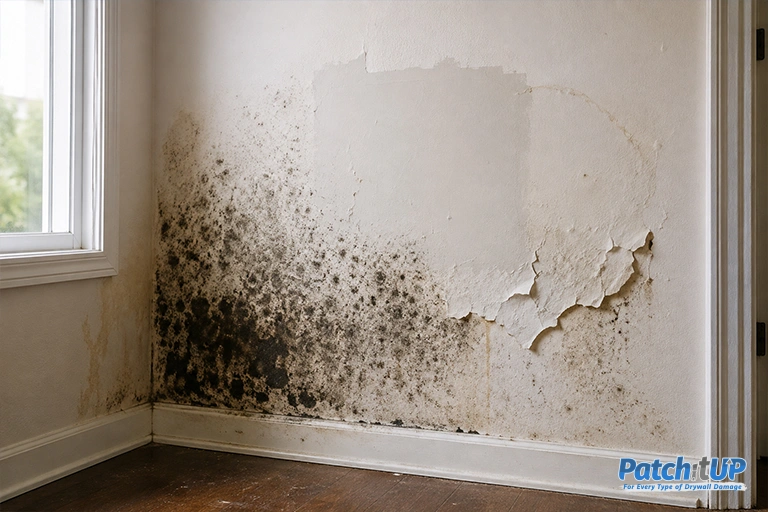
Why Painting Over Water Damage Backfires
Paint covers. It doesn’t dry anything out, and it definitely doesn’t kill mold. So the wall looks patched while the moisture behind it keeps working. About 47% of U.S. homes deal with dampness (Lawrence Berkeley National Lab / NIOSH prevalence studies). That can turn into mold, and once water sits, growth can start in a day or two.
Roll a fresh coat over a wet patch, and you’ve sealed the trouble inside the wall. Give it a few weeks: the stain ghosts back through, the board softens, and spores drift into the air at home.
Signs of Mold behind Drywall You Shouldn’t Ignore
These are the signs of mold behind drywall in Nassau County homeowners miss most. A wall usually warns you before anything turns green—five things to keep an eye on.
1. Stains that keep coming back
Brown, yellow, sometimes a dull gray. A ring like that means water’s been parked behind the wall a while. Cover it, and it bleeds back through in a few weeks.
2. A smell that won’t leave
You’ve cleaned the room top to bottom, and that damp, basement-y odor still hangs around. Nine times out of ten, that’s mold you haven’t found yet.
3. Paint that bubbles or peels
When paint lifts or blisters, something behind it is wet. Recoat it, and you’re back to the same mess in a month.
4. A wall that feels soft
Press on it. If it flexes, feels damp, or crumbles under your thumb, the gypsum’s already shot. That’s past cosmetic.
5. Allergies that ease when you leave the house
Sneezing, a stuffy nose, itchy eyes at home that clear up once you’re out for the day. Somewhere around 4.6 million asthma cases (Mudarri & Fisk, 2007, in the journal Indoor Air) in the U.S. trace back to damp, moldy homes.
What Makes Nassau County Homes More Prone
Long Island doesn’t make this easy. Between the ocean humidity, the nor’easters every winter, and housing that’s stood since the Levittown days, our walls soak up more moisture than most. Ground floors and basements catch the worst of it. We’ve pulled soaked board out of Garden City colonials and Long Beach split-levels where a slow pipe leak sat unnoticed for months. The 2023 American Housing Survey actually reports 11.2 million homes with water leaks from inside the structure in a single year.
What to Do Instead of Repainting
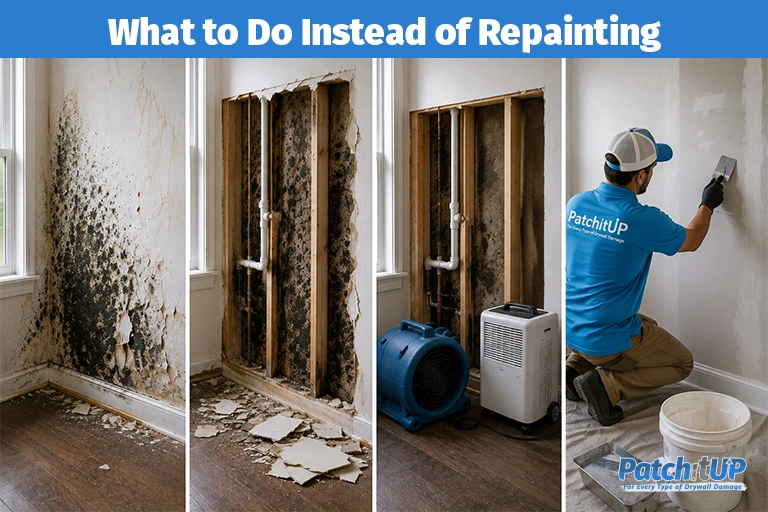
Fixing mold behind drywall in Nassau County the right way comes down to order.. Skip a step, and you’ll be back at it by spring.
- Kill the source first. A dripping pipe, bad flashing, poor grading outside, whatever’s letting water in has to get fixed first.
- Dry it all out. The EPA says get water-damaged spots dry within 24 to 48 hours.
- Pull out what’s ruined. Soaked drywall and insulation come out. You can’t just seal over them and hope.
- Rebuild and prime—fresh board, a stain-blocking primer, then your paint.
Straight talk: once mold gets past a small patch, this isn’t a Saturday project. If it’s bigger than a dinner plate, or you smell it but can’t find it, get a certified crew in.
Mold Behind Drywall in Nassau County: Local Help You Can Trust
This is where knowing the area pays off. PatchitUP works with homeowners all over Nassau County, from Hempstead and Freeport to Garden City, Oyster Bay, and Long Beach. We’re EPA Lead-Safe Certified and Google Guaranteed, and every job comes with a 1-year satisfaction guarantee. Call us at (516) 373-6765 for a free estimate.
The Bottom Line
That’s the smart way to handle mold behind drywall in Nassau County High humidity and aging Nassau County homes make damp walls a common issue. Nassau County houses, damp walls are just part of their life out here. But don’t reach for the paint. A stain, a musty smell, wall paint shedding, or a soft spot means water’s already behind the wall, and hiding it only pushes the real cost further out. Do it properly: dry the area, cut out the drywall board, then finish. That keeps a small repair small. Not sure how bad it’s gotten? Have someone local look before it spreads.
Frequently Asked Questions
Q: Can you paint over mold on drywall?
A: No. The paint covers the mark, but the mold keeps growing behind it. Dry the spot, take out the bad drywall, prime, then paint.
Q: How do I know if mold is behind my drywall?
A: Look for brown or yellow and green stains, bubbling paint, a smell that just won’t quit, soft patches, and allergies that ease off when you leave the house.
Q: How fast does mold grow behind walls?
A: Quick. Once water’s present, it can take hold in 24 to 48 hours, so dry anything wet right away.
Q: Is mold behind drywall dangerous?
A: It can be. It’s tied to asthma and allergies, and over time it eats away at the drywall and framing.
Q: Should I replace or clean drywall with mold?
A: If it’s soaked into the board, replace it. A pro can tell you how far it’s actually gone.
Q: Which is the best company to remove mold and fix drywall in Nassau County?
A: PatchitUP. We’re EPA Lead-Safe Certified, Google Guaranteed, and we work with homeowners all over Nassau County, backed by a 1-year guarantee. Grab a free estimate today.