Humid summers and dry winters cause drywall to expand and contract year-round, and that constant movement cracks seams, pops nails, and separates joints. If you’re seeing hairline cracks, bubbling paint, or ceiling stains, it’s humidity damage, not bad luck. PatchitUP repairs the wall and the underlying cause, so the crack doesn’t just come back next August.
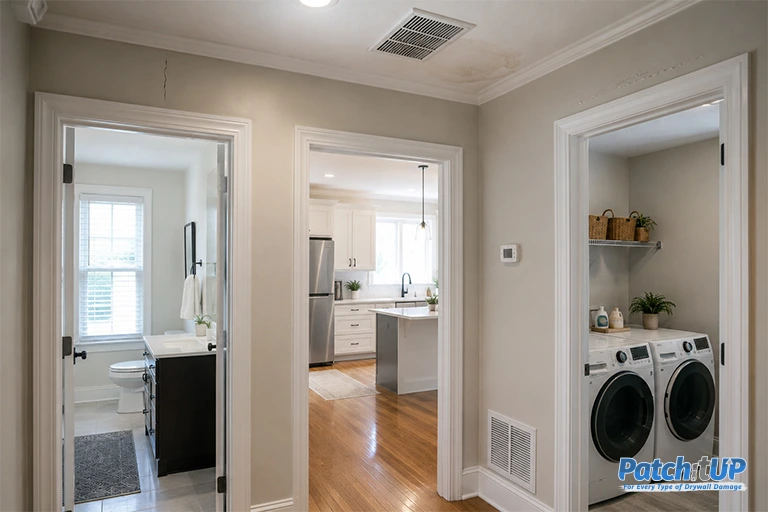
Why Does Humidity Crack Charlotte Drywall?
Drywall is gypsum wrapped in paper, and both materials absorb and release moisture with the seasons. In Charlotte, summer humidity regularly climbs past 80%, so the board swells. Then the winter air dries it out again, and it contracts again.
That push-pull doesn’t stop at the drywall. Charlotte sits on clay-heavy soil that expands when wet and shrinks when dry, and that movement transfers straight into your foundation and framing. Add an older housing stock (a lot of Charlotte homes date to the 1950s-70s), and you’ve got walls fighting a two-front war: seasonal humidity from the inside, shifting soil from the outside.
What Are the Warning Signs of Humidity Damage?
Most homeowners don’t catch this until it’s been building for months. Here’s what to actually watch for:
- Hairline cracks near door and window corners
- Ceiling cracks that reappear in the same spot every year
- Nail or screw pops (small bumps under the paint)
- Bubbling, flaking, or peeling paint
- Visible seams where drywall panels meet
- Soft or spongy spots (this means water, not just humidity — treat it as urgent)
- Musty smell with no visible source
Soft, spongy drywall is a different problem than a hairline crack. That’s active moisture, and in Charlotte’s climate, it can turn into mold in as little as 24 to 48 hours if it’s not addressed.
Which Rooms in Your Home Are Most at Risk?
Not every wall in your house takes the same beating. Moisture-heavy rooms and poorly ventilated spaces fail first:
- Bathrooms (especially without exhaust fans)
- Kitchens
- Laundry rooms
- Basements
- Garages
- Any room near an HVAC unit or condensate line
- Single-pane windows and sills in older homes, where condensation soaks into the surrounding drywall
If you’re in an older section of Charlotte — Dilworth, Myers Park, Plaza Midwood, that era of housing, you’re statistically more likely to be dealing with both settling cracks and humidity damage at once.
Can You Prevent Humidity-Related Drywall Damage?
You can’t control Charlotte’s weather, but you can control what happens inside your walls. This is the checklist that actually moves the needle:
- Keep indoor humidity between 30-50% (a $30 hygrometer will tell you where you stand)
- Run exhaust fans in bathrooms and kitchens every time, not just when it’s obviously humid.
- Get your HVAC serviced annually — condensate leaks are a top cause of “mystery” ceiling stains.
- Fix roof and plumbing leaks the day you find them, not the day it’s convenient.
- Improve attic ventilation
- Walk your ceilings and walls every season and look for anything new.
Should You DIY This or Call a Pro?
Here’s the honest answer: spackle and a fresh coat of paint hide the symptom, not the problem. If the underlying movement is still happening, that “repaired” crack reopens in the same spot, usually within a year.
A professional evaluates what’s actually causing the damage before touching a trowel:
- How far the movement or moisture has spread
- Whether the joint tape or drywall paper has lost integrity
- What texture matches the wall needs (Charlotte homes range from heavy orange peel to knockdown to smooth)
- Whether a leak or ventilation issue needs fixing first
Skipping that step is the single biggest reason DIY drywall repairs fail.
Trust PatchitUP for Drywall Repair in Charlotte
Seasonal humidity is just part of living here — damaged drywall doesn’t have to be. PatchitUP repairs cracked walls, popped seams, and water-stained ceilings across Charlotte with texture-matched, paint-ready results, and we tell you upfront if the real issue is a leak or ventilation problem instead of just patching over it.
Serving Charlotte and surrounding areas, including Dilworth, Myers Park, Plaza Midwood, and SouthPark.
Final Thoughts
Charlotte’s humid summers and dry winters can gradually damage drywall, but addressing small problems early can prevent larger, more expensive repairs later. If you’ve noticed recurring cracks, peeling paint, visible seams, or ceiling stains, it’s time to take action before moisture causes further damage. PatchitUP provides professional drywall repair in Charlotte, identifying the root cause of the issue and delivering seamless, long-lasting repairs that restore your walls and ceilings to a smooth, paint-ready finish.
FAQ For Drywall Repair in Charlotte: Humidity Damage Signs
Does humidity really damage drywall?
Yes. Humidity makes drywall expand, dry air makes it contract, and that repeated cycle cracks seams and pops nails over time.
When should I schedule drywall repair in Charlotte?
As soon as you see recurring cracks, bubbling paint, visible seams, or stains on the ceiling. Waiting only makes the repair bigger.
Can painting fix humidity-related drywall damage?
No. Paint covers the surface, not the cause. The drywall needs to be repaired first, or the crack will come back.
Which rooms get hit hardest by humidity?
Bathrooms, kitchens, laundry rooms, basements, and garages — anywhere moisture and poor ventilation combine.
How can I prevent drywall damage from humidity?
Keep indoor humidity between 30% and 50%, run exhaust fans, service your HVAC yearly, and fix leaks immediately.